Animation
Start
In this creative writing seminar, students will produce experimental approaches to popular variants of isekai genres in web novels, comics/manga, anime, visual novels, video games, films, and other media. We'll also draw inspiration from a broader global history of other world or portal fantasy narratives, ranging from historical novels like Alice's Adventures in Wonderland (Lewis Carroll, 1865) to recent video games like the literal walking simulator Baby Steps (Bennett Foddy, 2025). Building from these traditions, the course explores isekai not only as a genre but as a set of formal devices: transformation, leveling, save points, world rules, and so forth. We'll ask how stories change when protagonists are reborn as objects, interfaces, monsters, systems, or institutions, and what it means to write from within worlds structured by gaming conventions like stats, menus, maps, and mods. In the other direction, we'll ask how isekai can itself operate as an experimental mode of video game criticism. Using a collective workshop format, students will engage in a series of creative experiments that may include web novels, memes, interactive narratives, TTRPGs, dating sims, comics, machinima, net art, and collaborative hybrid forms that blur writing, play, and poetics. Studying genre conventions alongside literary history, contemporary media, fan cultures, and video games, we'll develop our own methods for writing beyond the looking glass. No previous training in another world required.
Course materials may include web novels, manga/comics, anime excerpts, games, criticism, and experimental writing across digital platforms. Most readings and media will be distributed online or linked through the course hub.
If any purchases become necessary, they will be kept minimal and announced in advance. The aim is to make the portal as accessible as possible while still giving us a wide field of worlds, systems, and forms to work with.
As a general outline for the course, take note that these are broad strokes subject to change. This seminar is fully interactive, growing and responding to its users. Each week will build on previous weeks, class conversations, and the directions that our study happens to follow.
The content of the syllabus will be updated regularly as a result, though the requirements will remain fixed. The syllabus will only be completed after we finish the course, and all research, including your own, has been collected.
We only have a handful of chances to meet over the quarter, during which we'll often work collaboratively to produce meaningful engagement with each other's work and develop new experiments as a group. Absences will cut into your participation percentage.
If you must miss a class, it is your responsibility to make arrangements with me both before and after the absence.
This seminar will develop critical and creative approaches to isekai, portal fantasy, and world-switching narratives across media. Together we will study genre conventions, analyze systems and interfaces as forms, and produce experimental works that move between writing, play, criticism, and design.
By the end of the quarter, students should have a growing portfolio of multimodal experiments alongside a stronger vocabulary for thinking about narrative transformation, game structures, collaborative creation, and writing inside rule-bound worlds.
Throughout this course, our central meeting place will be Discord. It will function as the course management hub for announcements, links, prompts, workshop conversation, and shared discoveries.
An invitation and signup to the dedicated private server will occur on our first meeting. Responsive posts are required.
This seminar will use ongoing posts as cross-world relays for experiments, references, fragments, and creative process between meetings.
Posts may take the form of text, image, interface sketch, map, character sheet, meme, clip, game artifact, or any hybrid form the course ends up inviting.
Because the course moves between writing workshop, media analysis, games, and interface-based experiments, a laptop or desktop computer is strongly recommended. A phone or tablet may be useful for some activities, but it will not comfortably cover the full range of formats we are likely to explore.
If your setup creates any barriers, please reach out early so we can make the course workable with the tools you have.
This course aims to make room for multiple modes of reading, writing, speaking, making, and participating. Please call attention to any access need that would improve the seminar, whether that involves text size, pacing, media format, sensory environment, platform choice, or something more specific to the forms we are using.
All possible accommodations will be made. For additional support, students may also contact the CAE at (310) 825-1501 or visit cae.ucla.edu.
| Course Actions | Due Date | % of Grade |
|---|---|---|
| Seminar Attendance & Play. (See descriptions above.) This is a collaboration-based course. We only get to meet on a handful of occasions this quarter—your input before, after, and during each session is paramount to the course’s function & collective success. | Ongoing | 20% |
| Experiment Posts. This course will require regular experiments on a range of platforms using a pseudonym. Your timely engagement with the weekly experiment will enable the ongoing workshop conversation of the course. Please note that these are experiments in the fullest sense—you are expected to play, fail, discover, and surprise yourself. Grades will be non-qualitative given timely assignment fulfillment. | Ongoing, due Tuesday evenings | 20% |
|
Discord Server Interactions. Playful, constructive, collaborative, civil, expanding, informal conversation should characterize the “seminar room” that is Discord. This includes: gathering & sharing resources; responding to peers’ works & sharing your own creative process; idle chatter; pet pictures; etc. Before each session, you should at minimum share: 1) Your experiment and reflections on your process and how the work responds to weekly prompts and inputs. 2) At least two responses to peers’ works. 3) Something Else. |
Ongoing, due before class meetings | 20% |
| Pecha Kucha. Final session final project rapid-fire presentations and other world party. | 6.3.26 | 10% |
| Final Project. Open format, open platform, full creative license. Play with a system we haven’t had a chance to explore or develop a previous experiment into a full-fledged work. Must synthesize and respond to course materials & conversations. Collaboration, invention, exploration all encouraged. Group finals are entirely encouraged. We will develop the scale & scope of final projects in conversation. | 6.12.26 | 30% |
Media Key
Artwork
Comic
Video Game
Live Action
Manga/Manwha
Moving Image
Web Novel
Poem
TTRPG
Academic Book
Web Toon
Fan Wiki
Essay/Article
XR/VR
Course Outline
Creative Writing in Another World With Your Absurd Skills.
Experiment:
Let's worldbuild! For this first exercise, we'll begin by brainstorming and pitching ideas for our collective web novel "TITLE TBD." We'll also work to roll up some characters that we can play together over the quarter ahead. As a reminder, here's the general idea:
A creative writing seminar is isekai'd all at once into another world. But they're trapped as voices within the same non-human body. Think "Reborn as a Vending Machine" meets Disco Elysium. What is this body? Where are they? What are they going to do? We'll write the diary of this entity from our own perspectives each week. What character do you want to play? What is their backstory? What are their hopes or motivations? Their struggles or failings?
We'll make some collective decisions in our next session. This week: let's prepare, explore, and brainstorm! For your experiment response to Discord this week, post ~500 word treatments in whatever form you prefer to pitch some worldbuilding ideas. Be descriptive! Consider genres, tropes, themes, arcs, characters, powers, game systems, anything that will help us do some collaborative worldbuilding. Explore references on the syllabus and PDFs in course Discord to help imagine, including TTRPGs like Journey or The Ground Itself if you'd like some mechanics for the experiment. As always, suggestions for the syllabus are more than welcome!
Study x Inspiration:
Bo Ruberg, How to Queer the World: Radical Worldbuilding through Video Games, 2025.TXT
Marie-Laure Ryan, A New Anatomy of Storyworlds: What Is, What If, As If, 2022.TXT
Stefano Gualeni and Riccardo Fassone, Fictional Games: A Philosophy of Worldbuilding and Imaginary Play, 2022.TXT
Kobold Press, Kobold Guide to Worldbuilding, Volume 2, 2022.TXT
Eddie Paterson, Timothy Williams, and Will Cordner, Once Upon a Pixel: Storytelling and Worldbuilding in Video Games, 2019.TXT
Trent Hergenrader, Collaborative Worldbuilding for Writers and Gamers, 2018.TXT
Kobold Press, Kobold Guide to Worldbuilding, 2013.TXT
Mark J.P. Wolf, Building Imaginary Worlds: The Theory and History of Subcreation, 2012.TXT
I've Been Making Micro TTRPGs for 300 Years and Maxed Out My Level
Experiment:
Create a tabletop role playing game (TTRPG) in one page or around 200 words. Explore examples here on the syllabus for inspiration and formal ideas. You may develop your game around an existing game (to "hack" or "jam") or invent something entirely new. IMPORTANTLY, use this game as a way to further build, explore, and invent our shared worldbuilding project. Perhaps you want to simulate the mechanics by which our characters take control (see Everyone is John)? Or to invent maps that might house them (see The Ground Itself)? Or might build a shared body for our PC (see LOSS)? The connection can be central or tenuous (a core issue or wild periphery), the aim is to think expansively about how writing (and playing!) a TTRPG might reveal compelling emergent storytelling.
Consider playing your game IRL: how might you play with a group of peers around a table? What would be fun to use as props, tools, mechanics, devices? Write your game to be played in roughly a class session or shorter. We'll group up in class and each group will select a game (or more) to play. Prepare to pitch your game for play and to play it as your groups decides!
If it helps, you can treat the 200 Word RPG Challenge, the challenge winners, the One Page Dungeon Contest, the 24XX Jam, or the WSCA Jam as loose models.
Study x Inspiration:
Bruno Bord, Micro RPG Catalog: A Bunch of Resources for Micro-Mini RPG Systems, ongoing.WRI
Jeff Howard, Quests: Design, Theory, and History in Games and Narratives, 2022.TXT
Monte Cook, Your Best Game Ever, 2019.TXT
Ashley M.L. Brown, Sexuality in Role-Playing Games, 2015.TXT
Jennifer Grouling Cover, The Creation of Narrative in Tabletop Role-Playing Games, 2010.TXT
Matt Barton, Dungeons and Desktops: The History of Computer Role-Playing Games, 2008.TXT
Play x Explore:
Cassi Mothwin, Tangled Blessings, 2023.RPG
Ehron Lime, What's So Cool About Being Transported Into An MMORPG And Getting Stuck There?, 2022.RPG
Jordan Palmer, Our God Is Dead, 2021.RPG
Sinta Posadas, Bonsai Brawlers!, 2019.RPG
Nate Treme, Tunnel Goons, 2019.RPG
Everest Pipkin, The Ground Itself, 2019.RPG
Grant Howitt, Honey Heist, 2017.RPG
Stephen Dewey, Ten Candles, 2015.RPG
John Harper, Lasers & Feelings, 2013.RPG
Jeffrey Grant and Michael Sullivan, All Outta Bubblegum, 2001.RPG
Re:FanFic -Publishing Zines in Another World-
Experiment:
This week, we'll build a little paper portal. Make a one-page fandom zine that either brings a character from a fantasy world into ours (reverse isekai), sends a character from our world into a fantasy world (isekai), or crosses over characters from any chosen fandom with a real engagement with isekai. Think about how fandom circulates, annotates, archives, ships, bends, and transforms worlds. What happens when a zine becomes a field guide, travel brochure, spell book, religious tract, rumor mill, bestiary sheet, or survival manual for crossing over to another world? The zine should be "authored" by your character in our collective worldbuilding exercise. Use this layer of authorship fiction to further add to your character for our ongoing collective production.
Your one-page zine can be composed by any method or tool you prefer. You can draw it by hand, collage it, photocopy it, lay it out in Canva or InDesign, or use something like Nathalie Lawhead's very cool Electric Zine Maker. Keep it to one 8.5" x 11" page that can fold into 8 small pages as demonstrated on the Discord; if you'd like, you can also hide something on a full-page secret interior. In either case: make it FULLY DESIGNED for publication! I'll print them in advance so in class we can cut, fold, and swap together.
For your experiment response to Discord this week, post a printable version of your zine and tell us about how and why you produced it. Be playful and descriptive. Let the form do some storytelling. You might focus on one character, a ship, a monster ecology, a dungeon, a bureaucratic system, a magic item, a keepsake, a map, a fake ad: how can a zine DO worldbuilding? Explore the references on the syllabus for zine culture, fan production, and archives of small-press circulation. As always, suggestions for the syllabus are more than welcome!
Study x Inspiration:
Allie Rigby, Inside Zine Festivals (and Why Zines Matter), 2024.WRI
Danny Snelson, Grey Libraries: Publishing as Pedagogy, 2024.WRI
Kaitlyn Tiffany, Everything I Need I Get from You: How Fangirls Created the Internet as We Know It, 2022.TXT
Francesca Coppa, The Fanfiction Reader: Folk Tales for the Digital Age, 2017.TXT
Molly McArdle, This Is How Star Trek Invented Fandom, 2016.WRI
Abigail De Kosnik, Rogue Archives: Digital Cultural Memory and Media Fandom, 2016.TXT
Anne Jamison, Fic: Why Fanfiction Is Taking Over the World, 2013.TXT
Lisa Gitelman, Amateurdom and Its Discontents, Or, What Is a Zine?, 2013.MOV
Janice Radway, Zines, Half-Lives, and Afterlives: On the Temporalities of Social and Political Change, 2011.WRI
Liz Worth, Despite What You've Heard, Zines Aren't Dead, 2011.WRI
Stephen Duncombe, Notes from Underground: Zines and the Politics of Alternative Culture, 2008.TXT
Chip Rowe, The Book of Zines, 1996-2025.TXT
Play x Explore:
Monoskop Wiki, Zine Culture Resources, ongoing.WIK
Silvio Lorusso et al., Post-Digital Print Archive, ongoing.ART
Internet Archive, Zine Collection, ongoing.WRI
Graham Cooling, Coke Oven, ongoing.ART
Reddit, r/zines, ongoing.WRI
Organization for Transformative Works, History of Media Fanzines, ongoing.WIK
Plastiboo, Vermis I: Lost Dungeons and Forbidden Woods / Vermis II: Mist & Mirrors / Vermis III: Old Curses & Buried Horrors, 2023-2025.ARTARTART
Paul Soulellis, Queer.Archive.Work, 2018-present.ART
Antoine Lefevre, ARTZINES, 2016-2023.ART
Daniela Capistrano et al., POC Zine Project, 2010-present.ART
QZAP, Queer Zine Archive Project, 2003-present.ART
So I'm a Bitsy Game, So What?
Experiment:
This week, we're continuing our miniature experiments by building a Nano RPG with the remarkably intuitive Bitsy game maker. You can click the ? for information about each window. Play around with it! For a more guided experience, see Claire Morwood's excellent tutorial or the Getting Started with Bitsy guide produced by NVM.
Once you've finished your Bitsy game, you'll be able to export it as an HTML file. You can upload that directly to itch.io to share it there, and everyone should have an itch.io account regardless. For this experiment, again, the "author" pseudonym should be your character in our collective worldbuilding experiment.
As for content, the aim is to make a tiny RPG isekai. Consider our featured work, OneShot, as a guide, as well as the resources in this week of the syllabus. How can a small narrative game help develop our worldbuilding enterprise? What kinds of genres can you experiment with inside this minimal interface? How can tiny sprites tell big stories?
The form and genre of your Bitsy game are up to you. Make the kind of game you'd most want to play. Don't feel constrained by the story we've told so far: feel free to adventure out from the ballroom to explore and invent other areas of this world. Perhaps you want to build out from your fandom zine. Or you might produce a new area with new characters whom we may encounter ahead. Totally open format, and enjoy experimenting with Bitsy this week!
Study x Inspiration:
Milena Droumeva, ed., Playthrough Poetics: Gameplay as Research Method, Amherst College Press, 2024.TXT
Cameron Kunzelman, The World Is Born From Zero: Understanding Speculation and Video Games, De Gruyter, 2022.TXT
Claudia Costa Pederson, Gaming Utopia: Ludic Worlds in Art, Design, and Media, Indiana University Press, 2021.TXT
Anastasia Salter and Stuart Moulthrop, Twining: Critical and Creative Approaches to Hypertext Narratives, Amherst College Press, 2021.TXT
Aubrey Anable, Playing with Feelings: Video Games and Affect, University of Minnesota Press, 2018.TXT
Stephanie Boluk and Patrick LeMieux, Metagaming: Playing, Competing, Spectating, Cheating, Trading, Making, and Breaking Videogames, University of Minnesota Press, 2017.TXT
Anna Anthropy, Rise of the Videogame Zinesters: How Freaks, Normals, Amateurs, Artists, Dreamers, Drop-outs, Queers, Housewives, and People Like You Are Taking Back an Art Form, Seven Stories Press, 2012.TXT
Play x Explore:
Jump Over The Age, Citizen Sleeper 2: Starward Vector, 2025.GAM
sunset visitor, 1000xRESIST, Fellow Traveller Games, 2024.GAM
Love-de-Lic, moon: Remix RPG Adventure, ASCII Entertainment, 1997 (JP); Onion Games, 2020.GAM
Radical Fish Games, CrossCode, 2018.GAM
CyberConnect2, .hack//G.U. Last Recode, 2017.GAM
SCP Wiki community, SCP Foundation, 2008-present.WIK
Special Guest Workshop:
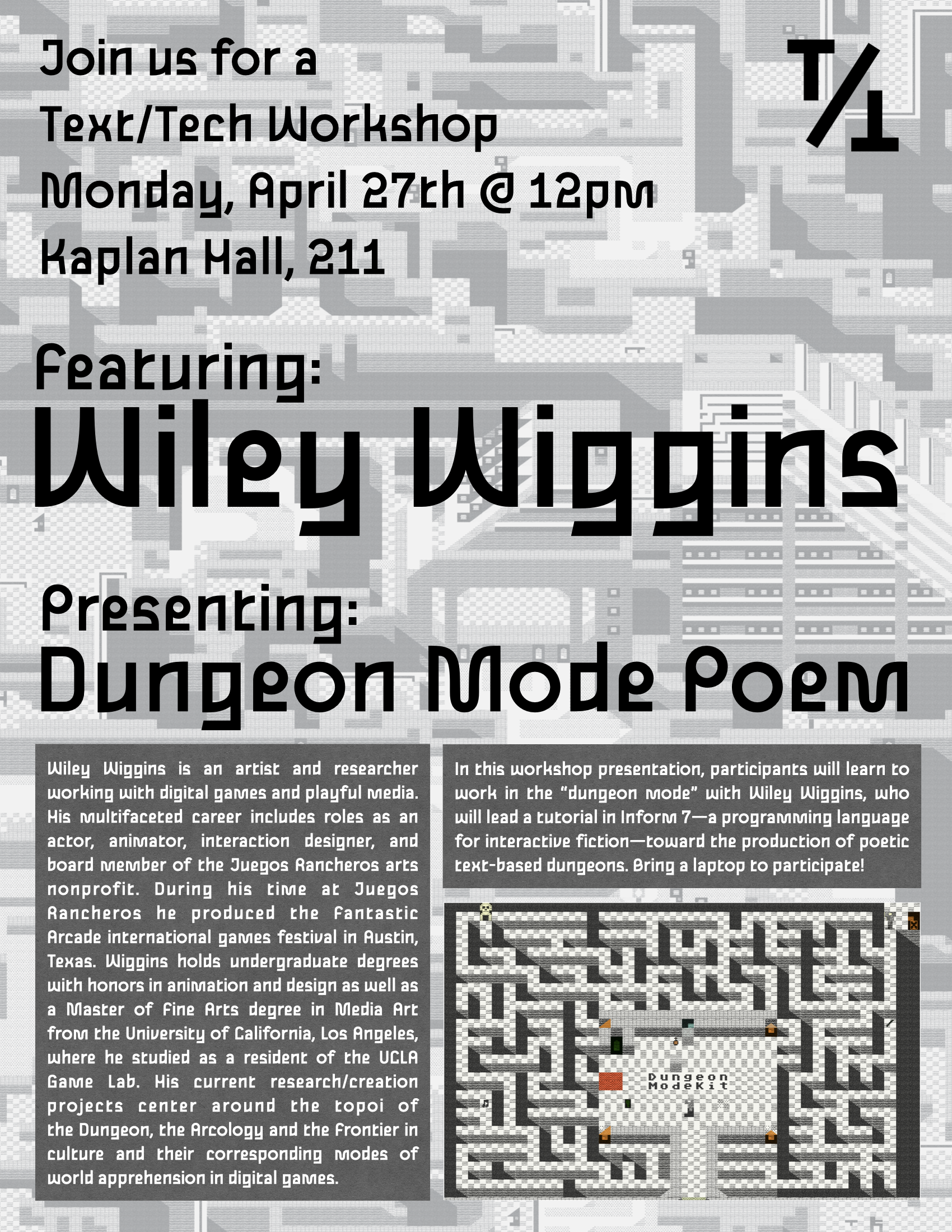
Wiley Wiggins
Trapped in a Dating Sim: The World of Otome Games Is Tough for Bruins
Experiment:
This week, we'll be experimenting with the amazing visual novel engine Ren'Py. We'll be picking up on our collective live RP session in order to successfully offer four quests in four locations. These visual novels will continue our ongoing web novel in a playable format. Your assigned groups have full autonomy to build the environment and scenario you want to explore, as well as the genre conventions, characters, and visual style of your collaborative work.
For this experiment, be sure to take advantage of the extensive community documentation and this highly rated beginner tutorial for Ren'Py. The language is very intuitive, and once you have the basics down, you can quickly get into telling a branching visual narrative. For the visual assets, feel free to use any method: drawn by hand, digitally composed, found online, photos you've taken, character generators, or even, gasp, generative images, if you feel comfortable working with those tools. For example, you can generate locally with a small model using DiffusionBee or something similar.
For your collaborative work, consider assigning different roles based on interest within your group, or plan a jam session so you can work together simultaneously. The method is up to you. The aim is to work within the conventions of the visual novel to play out a scenario in which your group, operating as a system, works to successfully entice one or more adventurers to accept a quest. From otome games and dating sims to detective plots, death games, and psychological horror, there are many approaches you might take to this experiment.
As a reminder, you'll work with your group privately this week, and we'll play and celebrate these visual novels in our next session, keeping each a surprise for a live playtest launch!
Collective x Focus:
Study x Inspiration:
DJ Pangburn, It's You vs. Pickup Artists in a Dating Simulator Inspired by "The Game", 2016.WRI
Play x Explore:
Yatsuki Wakatsu, Isekai Office Worker: The Other World's Books Depend on the Bean Counter, 2026.NOVMANANIWIK
saiyohara, rae, and LemonInk, Hexes & Heartstrings, 2025.GAM
Lena NW, Nightmare Temptation Academy, 2020.GAM
Angela Washko, The Game: The Game, 2019.GAM
Brianna Lei, Butterfly Soup, 2017.GAM
Brother, Love! Brother-kun, 2013.GAM
Emily Short, Galatea, 2004.GAM
VTubing in Another World with Level 2 Super Cheat Powers
Experiment:
This week, we all become VTubers! We'll venture out to invent and report on the world we're currently inhabiting. So far, we have a weird multi-species Arby's, a fantasy island with a mermaid reef, a cyberpunk tower with steampunk slums, and a Victorian library helmed by the sweetest trio in the biz. Let's build out from there! What else is there? What connects these domains? Why are our anachronistic worldbuilding dreams coming to fruition? You decide! Keep the story going, and remember we are ONE system trying to figure out where we are, how we got here, and the rules of this new world we find ourselves within.
This week: become a virtual persona, aka a VTuber, reporting on the events, personas, environs, changes, and/or structures of our newly shared world. There are many tools to get started, beginning with VTube Studio and many related software, for example customizing avatars with VRoid Studio. But you can also use any number of PNGTuber or VTuber tools this week, such as VSeeFace, Veadotube mini, Animaze, Meshy, or DomoAI. There are endless options for mobile, tablet, or console. You may use 2D images that you bring a voice to, animated or not. You may become a 3D avatar, custom built or customized. You may inhabit a fandom character you admire, citing original artwork or making your own. You may use your own character in this world or any other of your invention, feel free. The goal is to have fun inhabiting any other digital body in your reportage for this experiment.
Your task is to make a short video, under 5 minutes, that reports on any aspect of our shared world. You get to invent this aspect of our world, so don't be afraid to venture out into new territory. We must understand where we are, and in this exercise, we'll produce the map of the world as a whole.
Be sure to consider positionality in your videos. What bodies do you feel comfortable inhabiting? What are the limits to this kind of play? Importantly, be considerate of dimensions of race, gender, sexuality, and ability. How might you come to inhabit this virtual persona? What are the stakes, and what are the risks and rewards?
Post your Tubing videos to our Discord and enjoy this lighthearted venture into building out our world.
Special x Lecture:
Ren Dinh (UCLA), "VTubing & Its Dis/contents." (With special thanks to Ren for co-developing the curriculum for this week!)
Study x Inspiration:
Yiluo Wei and Gareth Tyson, Understanding the Consequences of VTuber Reincarnation, arXiv, 2026.WRI
Dakyeom Ahn et al., I Stan Alien Idols and Also the People Behind Them: Understanding How Seams Between Virtual and Real Identities Engage VTuber Fans - A Case Study of PLAVE, 2025.WRIWRI
Alice Teodorescu, Between Ustopia and the Affective Heterotopia: Vtubing and Its Fandom, in Inhabiting Ustopia: Science Fiction in Film, Performing Arts, and Digital Media, 2025.TXT
Kristi Valerie Mai, Model Me Like One of Your Asian Girls: The Role of Affective Attachments, Gendered Labor, and Race in Vtubing, UCLA M.A. thesis, 2025.TXT
Esperanza Miyake, Virtual Influencers: Identity and Digitality in the Age of Multiple Realities, Routledge, 2024.TXTTXT
Rossella C. Gambetti and Robert V. Kozinets, From Killer Bunnies to Talking Cupcakes: Theorizing the Diverse Universe of Virtual Influencers, 2024.WRI
Patrick Gwillim-Thomas, The Actualizing Platform: 2.5 Dimensions in the VTuber Media Ecology, Mechademia 15, no. 2, 2023.WRI
Yijin Li, Why Does Gen Z Watch Virtual Streaming VTube Anime Videos with Avatars on Twitch?, Online Media and Global Communication 2, no. 3, 2023.WRI
Miles Lee, [TECFIC] Beings: The Live Fiction of Virtual YouTubers, Mechademia: Second Arc 15, no. 1, 2022.WRI
Noel Brett, Why Do We Only Get Anime Girl Avatars? Collective White Heteronormative Avatar Design in Live Streams, Television & New Media, 2022.WRI
Stevie Suan, Performing Virtual YouTubers: Acting Across Borders in the Platform Society, in Japan's Contemporary Media Culture between Local and Global: Content, Practice and Theory, 2021.TXT
Tara Fickle, The Race Card: From Gaming Technologies to Model Minorities, NYU Press, 2019.TXT
Play x Explore:
Alison Nguyen, ANDRA8: my favorite software is being here, 2020-2021.ART
I Got a Cheat Skill in Another World and Became Unrivaled in Minecraft, Too
Experiment:
This week, we'll be playing Minecraft in collaboration with the Minecraft Bloc of Concordia University. The SMP For the Trees server is going live today. We'll jump in and have a group play session on Wednesday, so everyone should have Minecraft installed, plus the CurseForge app and mods installed by then. I'll drop in all instructions on joining and playing once the server goes live. Hopefully we can keep playing after the quarter is over as well, for those who are interested. Of course, it's not required, but it's already so fun! Keep an eye on the Discord for updates, and you may want to bring a mouse for Wednesday.
We'll use Minecraft Java for Mac or PC, but not mobile. As discussed, this project focuses on the "diegetic breach" of the actual solar servers installed in Montreal interfacing with the gameplay of this Reclamation-inspired modpack. We'll begin our exploration here, keeping in mind both the isekai elements of the modpack's quests and the ecological interface between our world and "another" world. In the meantime, continue developing final projects!
Minecraft Bloc "For the Trees" x UCLA:
Study x Inspiration:
Angelica Calcagnile, Andrew Rochon, Nat Torre, and Theodore Fox, Moloch's Gauntlet: New Undergraduate Pedagogical Perspectives in Minecraft, 2025.WRI
Larissa Hjorth, Ingrid Richardson, Hugh Davies, and William Balmford, Exploring Minecraft: Ethnographies of Play and Creativity, Palgrave Macmillan, 2021.TXT
Darren Wershler and Bart Simon, The Allegorical Build: Minecraft and Allegorical Play in Undergraduate Teaching, 2021.WRI
Michael Dezuanni, Peer Pedagogies on Digital Platforms: Learning with Minecraft Let's Play Videos, MIT Press, 2020.TXT
Bart Simon and Darren Wershler, Childhood's End (or, We Have Never Been Modern, except in Minecraft), 2018.WRI
Nicholas Watson, Procedural Elaboration: How Players Decode Minecraft, 2017.WRI
Nate Garrelts, ed., Understanding Minecraft: Essays on Play, Community and Possibilities, McFarland, 2014.TXT
Play x Explore:
The World's Finest Final Projects Get Reincarnated in Another World as a Co-Production
🧙♀️ FINAL PROJECT ATELIER 🧙♀️
This week, you'll work to start developing your final project. The aim is to get started in a concrete way on the production of yr work, &to map out next steps toward the end of the quarter.
This can take many different shapes &forms depending on yr idea. Perhaps you need to storyboard a webtoon? Or begin scripting a visual novel? Or initiate a build in Minecraft? Whatever it is, you'll need to post to this channel the following before Wednesday:
1) A description of the project. It can be informal, but aim to be as descriptive &comprehensive as possible. Discuss goals (what will it be), approach (how will you do it), hopes (what will it mean) &potential challenges (what hurdles will you face).
2) A concrete display of the project, in the forms or formats that are most urgent to get started. These can be screenshots of work in development, sketches of visual materials, storyboards of plot development, or any other format that's most useful for you. But the main thing is to get started in the platforms or formats that you'll be using for the project as a whole.
3) Every final project will have an "affinity producer" as assigned in class. The producer's role is to help you keep on schedule, to help develop ideas, to fight against scope creep (!), and to be a sounding board for all steps in the final project process. Everyone must have at least one meeting with their producers for all weeks to follow, with regular reports about how both their project and production process is proceeding.
Please do feel free to write at any time for advice, resources, or anything else you might need help with. &Don't forget that the course Discord server is built for community development: use the #idea-playground-ideas or #help-plz-lost channels to get input from the group. If you've got questions, yr peers will likely have answers (or will benefit frm the asking!).
Otherwise, take this extra time to actively develop your FINEST final project.
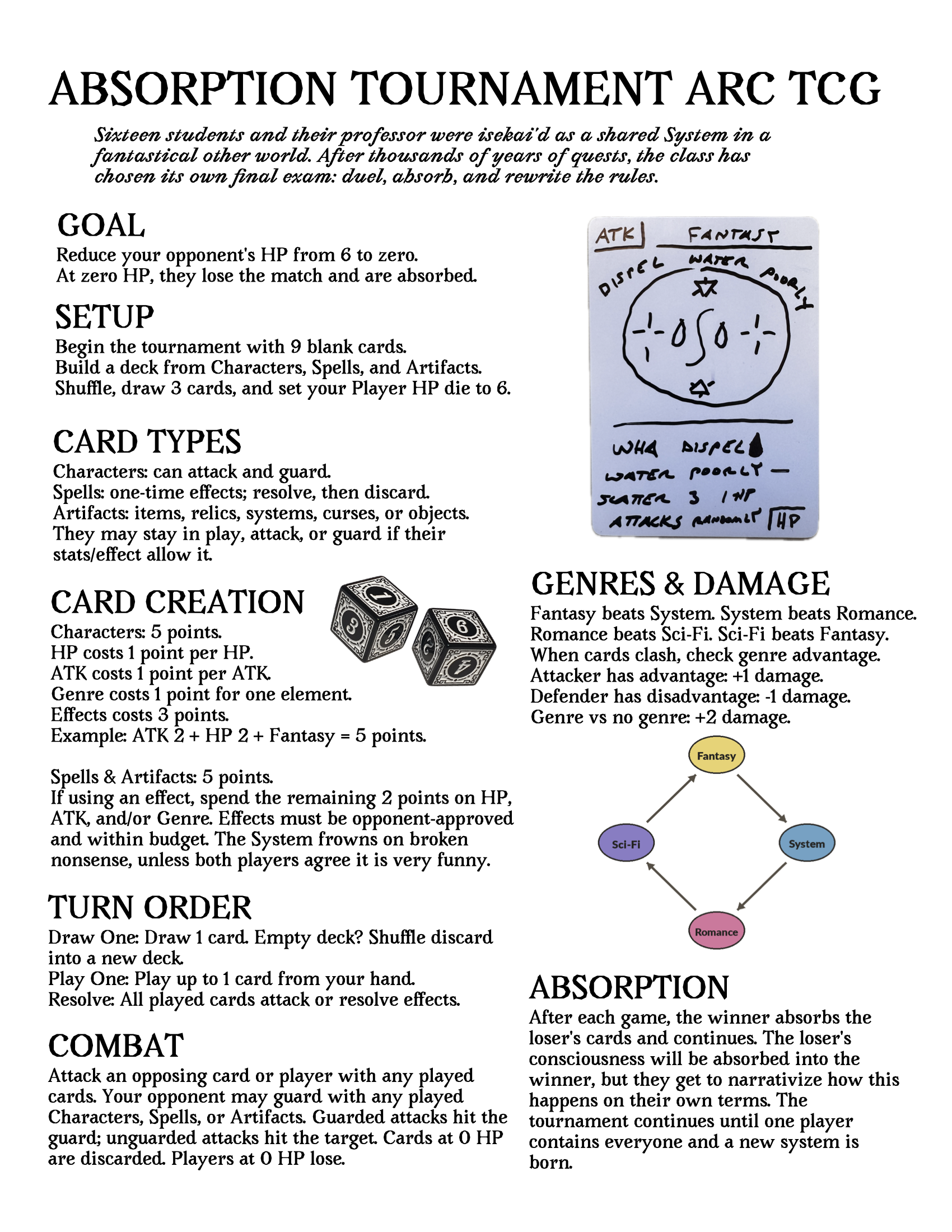
My Next Life as a Trading Card Game: All Routes Lead to Doom!
3D Printing Level 99: I May Be the Hidden Boss but I'm Not the Final Project
Special x Lecture:
Amber Hisatomi (UCLA), "(Re)playing the Past and Future: a Transmedia Study of Wong Kar-Wai's Film, 2046, and Sunset Visitor's Video Game, 1000XRESIST."
Absorption Narratives x Pecha Kucha:
For our final session, there are two main tasks and two optional tasks:
1) Absorption Narratives: See the #flash-fiction-absorption channel in DARK VOID for instructions. These should be short, poignant, final entries on each of your characters. Based on the results of the absorption tournament, decide how your character will exit our narrative. It's entirely up to you, and invention is encouraged. Please post short flash fiction 250-500 word posts anytime before Tuesday, so I can be sure to compile them into the FULL web novel of our course (my finals homework!).
2) Final Project Pecha Kucha: our final session will mainly consist of presenting and celebrating final projects using the Pecha Kucha format (20 slides x 20 seconds per slide: fully automated). It's like pitch deck karaoke! I've outlined the process and potential structures on our Discord. Please DM your deck to me anytime BEFORE Wednesday afternoon so I can organize &coordinate (&keep it a surprise for yr classmates!).
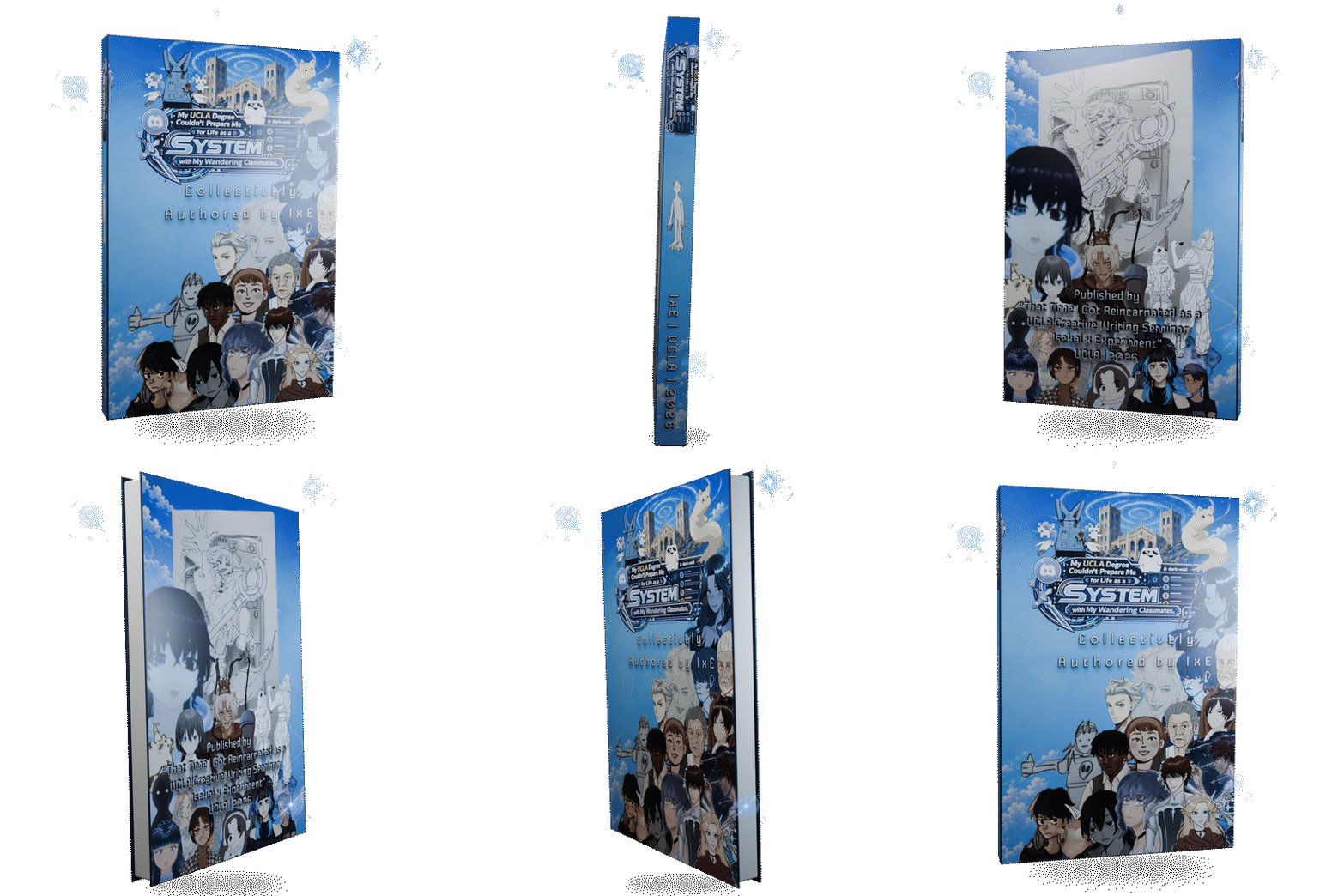
Optionally, if you have a 3D object that you'd like printed to commemorate our time in another world together, send it to me &we'll use UCLA resources to bring that other world into ours. The first of which will be our collective book, but many others may follow. The invitation is open at any time beyond the weeks of this course.
&Ongoing Optional: come play Minecraft For the Trees with us!